The Evolution of Tissue Regeneration—Choosing the Right PDRN for Your Next Innovation
For years, PDRN (Polydeoxyribonucleotide) has been recognized as one of the beauty industry’s most compelling regenerative ingredients. It has become a sought-after active in premium skincare, scalp care, and anti-aging formulations for its ability to support skin repair, strengthen the skin barrier, and improve overall skin quality.
Today, however, the conversation surrounding PDRN has evolved.
It’s no longer simply “Should I formulate with PDRN?”
Instead, innovators are asking a more strategic question:
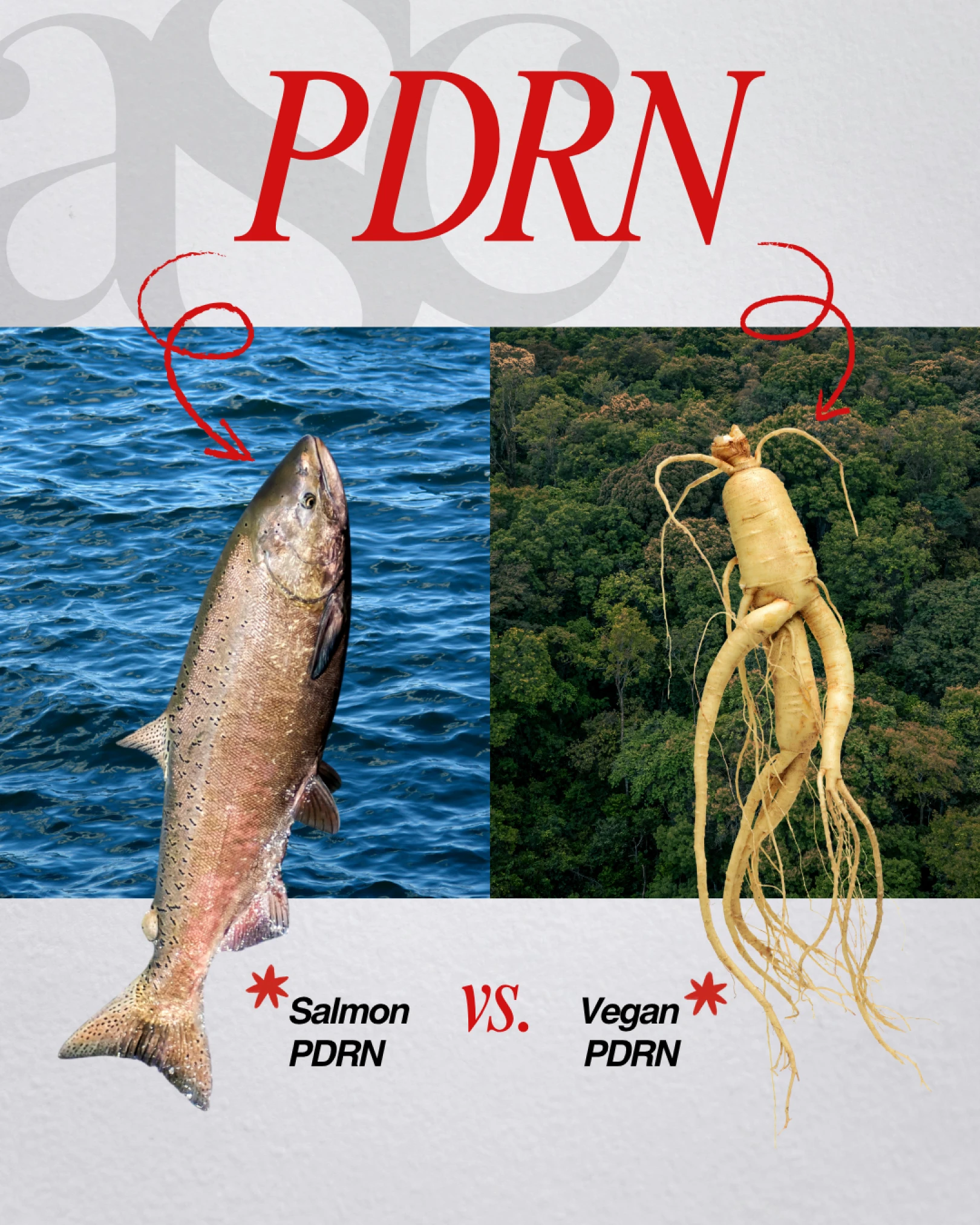
Should the next generation of PDRN come from nature’s oceans—or nature’s roots?
The emergence of plant-derived (Ginseng) PDRN has expanded the possibilities for formulators and beauty brands alike, offering a new approach that aligns with changing consumer values while maintaining the regenerative philosophy that made PDRN popular in the first place.
Rather than competing technologies, salmon-derived and vegan PDRN represent two different paths toward the same objective: supporting healthier, stronger-looking skin.
Understanding PDRN
PDRN is a collection of purified DNA fragments that interact with the skin’s natural repair mechanisms.
Research has shown that PDRN can activate adenosine A2A receptors, helping stimulate growth factors involved in tissue regeneration while reducing inflammatory responses. This dual mechanism has made it an ingredient of growing interest across both medicine and cosmetics.
In skincare applications, PDRN is commonly associated with benefits such as:
- Supporting skin regeneration
- Improving skin elasticity
- Strengthening the skin barrier
- Reducing visible signs of aging
- Enhancing skin hydration
- Promoting a healthier-looking complexion
- Supporting scalp health and hair care formulations
This broad functionality explains why PDRN has rapidly transitioned from medical applications into premium beauty products.
The Original Pioneer: Salmon-Derived PDRN
Salmon-derived PDRN is the version that introduced the beauty industry to this category.
Purified from salmon or trout DNA, its nucleotide composition closely resembles human DNA, making it highly biocompatible and extensively studied for regenerative applications.
Its long history of clinical and cosmetic use has established strong credibility among dermatologists, aesthetic practitioners, and formulators worldwide.
Because of this foundation, salmon PDRN continues to be favored for products emphasizing:
- Intensive skin repair
- Professional aesthetic skincare
- Anti-aging treatments
- Post-procedure recovery
- Advanced regenerative formulations
For brands positioning themselves around clinical efficacy and scientific heritage, salmon-derived PDRN remains a compelling choice.
A New Generation: Vegan (Ginseng) PDRN
Consumer expectations are changing.
Today’s premium beauty consumer increasingly evaluates products not only by performance, but also by ingredient sourcing, sustainability, and ethical considerations.
This shift has driven innovation toward plant-derived alternatives—including Ginseng PDRN.
Rather than extracting DNA from animal sources, Ginseng PDRN is produced using specialized purification technologies that isolate DNA fragments from ginseng roots.
The result is a PDRN ingredient designed to deliver regenerative benefits while supporting vegan product positioning.
Beyond its botanical origin, ginseng also carries a long history in traditional wellness and modern cosmetic research, making it a familiar and trusted ingredient across many Asian beauty markets.
For brands, this opens opportunities to create products that communicate both advanced biotechnology and naturally inspired innovation.
More Than an Ingredient—A Branding Decision
When selecting between salmon and vegan PDRN, the discussion often extends beyond efficacy.
It becomes a question of brand identity.
| Salmon PDRN | Vegan (Ginseng) PDRN |
| Established clinical heritage | Modern biotechnology innovation |
| Strong association with regenerative medicine | Aligns with vegan and sustainability positioning |
| Familiar within aesthetic skincare | Appeals to conscious beauty consumers |
| Premium medical-inspired image | Botanical science and ethical innovation |
| Extensive history in cosmetic applications | Emerging ingredient with growing industry interest |
Neither approach is inherently superior.
Instead, each communicates a different story to consumers.
And in today’s beauty market, stories matter.
The Consumer Is Changing—Should Your Ingredients Change Too?
Beauty purchasing decisions are increasingly influenced by values alongside efficacy.
Consumers now look for products that are:
- Vegan-friendly
- Sustainably sourced
- Ethically produced
- Scientifically validated
- Transparent about ingredient origins
This doesn’t diminish the value of salmon-derived PDRN.
Rather, it expands the landscape.
Brands now have the flexibility to choose an ingredient that best reflects their positioning and target audience.
Which PDRN Fits Your Product Strategy?
Instead of asking which ingredient performs better, consider what your product is designed to represent.
Choose Salmon PDRN if your brand emphasizes:
- Professional skincare
- Clinical aesthetics
- Post-treatment care
- Regenerative science
- Medical-inspired innovation
Consider Vegan (Ginseng) PDRN if your brand emphasizes:
- Clean beauty
- Vegan positioning
- Sustainable innovation
- Botanical biotechnology
- Next-generation cosmetic science
Ultimately, the right choice depends on the story your brand wants to tell.
Looking Ahead: The Future of Regenerative Beauty
The evolution from salmon-derived to plant-derived PDRN reflects something much larger than a new ingredient launch.
It reflects how the beauty industry itself is evolving.
Consumers increasingly expect products that combine proven science with responsible innovation. Manufacturers are responding by developing ingredients that not only perform—but also align with changing values around sustainability, transparency, and ethical sourcing.
For beauty brands, this creates new opportunities.
Whether rooted in established clinical research or emerging biotechnology, PDRN continues to represent one of the most exciting frontiers in regenerative skincare. The question is no longer whether regenerative beauty has a future—it clearly does. The more strategic question is how your brand chooses to participate in that future.
Key Takeaway
Salmon PDRN and Vegan (Ginseng) PDRN are not opposing technologies—they are complementary innovations serving different brand visions.
For brands rooted in clinical performance and medical aesthetics, salmon-derived PDRN offers a well-established path backed by years of use in regenerative applications. For brands focused on clean beauty, sustainability, and ethical innovation, plant-derived PDRN provides a compelling alternative that aligns with evolving consumer expectations.