Separating Scientific Innovation from Industry Buzz
Few ingredients have generated as much excitement in recent years as exosomes. They appear in premium serums, post-treatment skincare, scalp care, and anti-aging products, often accompanied by bold claims about skin regeneration and cellular communication.
At the same time, skepticism has grown.
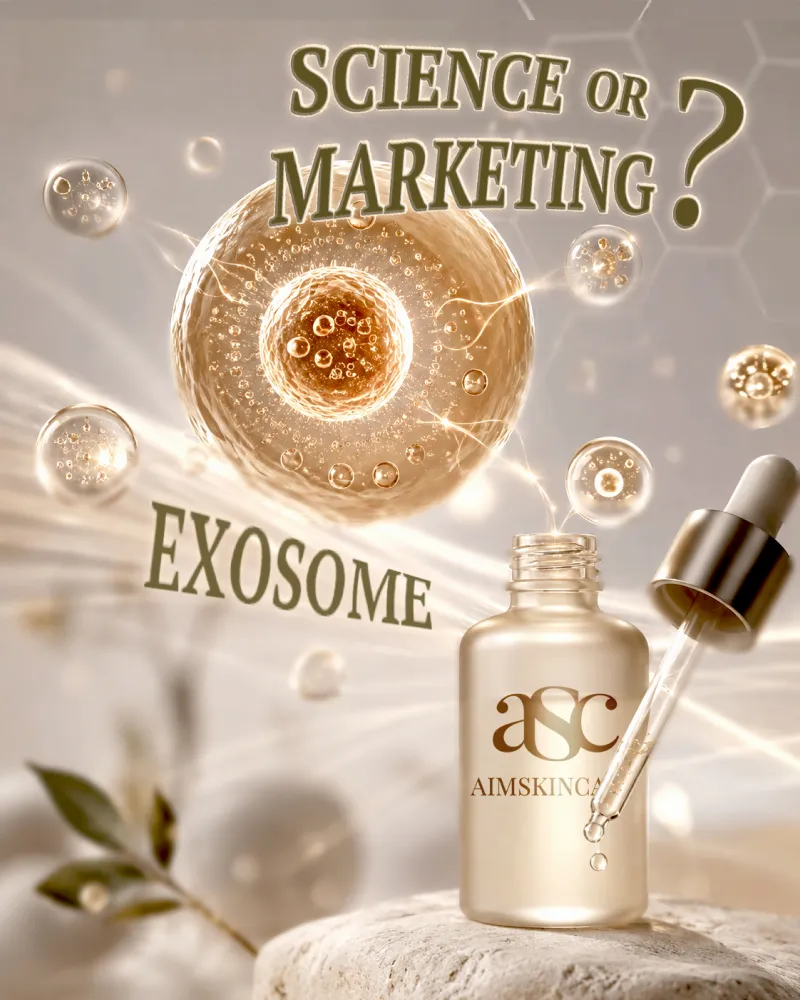
Are exosomes truly a breakthrough in cosmetic science—or have they become the industry’s latest marketing buzzword?
The answer lies somewhere in between.
First, What Exactly Are Exosomes?
Exosomes are naturally occurring extracellular vesicles (EVs)—tiny membrane-bound particles released by cells to communicate with one another.
Think of them as biological delivery vehicles.
Rather than performing a biological function on their own, exosomes transport proteins, lipids, peptides, RNA, and other signaling molecules between cells, helping coordinate cellular activities.
This concept has been extensively studied in regenerative medicine and drug delivery long before it entered the beauty industry.
In cosmetics, however, exosomes serve a slightly different role.
Why Are Exosomes Interesting for Skincare?
One of skincare’s biggest challenges has always been delivery.
A highly effective active ingredient provides little value if it cannot reach the skin cells where it is intended to work.
This is where exosome technology becomes particularly interesting.
Instead of simply adding botanical extracts or active ingredients into a formulation, these actives can be encapsulated within microscopic vesicles designed to improve stability and enhance delivery.
In simple terms:
The exosome acts as the delivery system—not necessarily the active ingredient itself.
Much like a courier delivering an important package, its value lies in ensuring the contents arrive where they are needed.
Science or Marketing?
Here’s where the conversation becomes more nuanced.
The science behind extracellular vesicles and cellular communication is well established.
What varies is how the term “exosome” is used commercially.
Some cosmetic ingredients are based on naturally derived extracellular vesicles. Others use exosome-inspired delivery systems or plant-based vesicle technologies designed to mimic similar delivery principles.
As a result, two products may both advertise “Exosome Technology,” while relying on very different technologies, ingredient sources, and levels of scientific evidence.
For brands and formulators, understanding this distinction is essential.
Looking Beyond the Label
When evaluating an exosome ingredient, it’s worth asking a few important questions:
- What is the source? Human, animal, plant, or microbial?
- What exactly is being delivered? Peptides, botanical extracts, growth factors, or other actives?
- Is the exosome itself the active ingredient, or simply the carrier?
- What evidence supports the ingredient’s claimed benefits?
- Is the technology appropriate for cosmetic applications and local regulations?
These questions often reveal more than the word “exosome” itself.
Why the Industry Is Paying Attention
Interest in exosome technology continues to accelerate, reflecting broader trends in regenerative science and advanced ingredient delivery.
Beyond skincare, exosomes have been widely researched in pharmaceutical drug delivery, tissue engineering, and regenerative medicine. As these fields evolve, cosmetic science is exploring how similar delivery principles can enhance product performance.
Market analysts also anticipate significant growth in the global exosome market over the coming decade, driven by continued investment in biotechnology and precision delivery systems. While much of this growth extends beyond cosmetics, it highlights the increasing scientific and commercial interest surrounding the technology.
For beauty brands, this signals an important shift: consumers are becoming more interested not only in what ingredients are used, but how those ingredients are delivered.
So… Science or Marketing?
The short answer is:
Both.
Exosome technology is rooted in legitimate scientific research, particularly in cellular communication and advanced delivery systems. At the same time, growing consumer interest has led the term to be used broadly across the beauty industry, sometimes with varying levels of scientific rigor.
For product developers and brand owners, the opportunity isn’t simply to formulate with an ingredient labeled “exosome.” It’s to understand the technology behind it, evaluate the supporting evidence, and determine whether it aligns with the product’s performance goals and brand positioning.
Because in today’s beauty industry, consumers are no longer impressed by scientific-sounding names alone.
They’re looking for innovations backed by credible science, transparent communication, and meaningful performance.
Product Developer’s Checklist
Before choosing an exosome ingredient, ask yourself:
✔ Is the technology supported by credible scientific evidence?
✔ What is the source of the exosome or vesicle technology?
✔ Is the exosome acting as the active ingredient, the delivery vehicle, or both?
✔ Does the technology align with your product’s claims and regulatory requirements?
✔ Will your consumers understand the value beyond the buzzword?